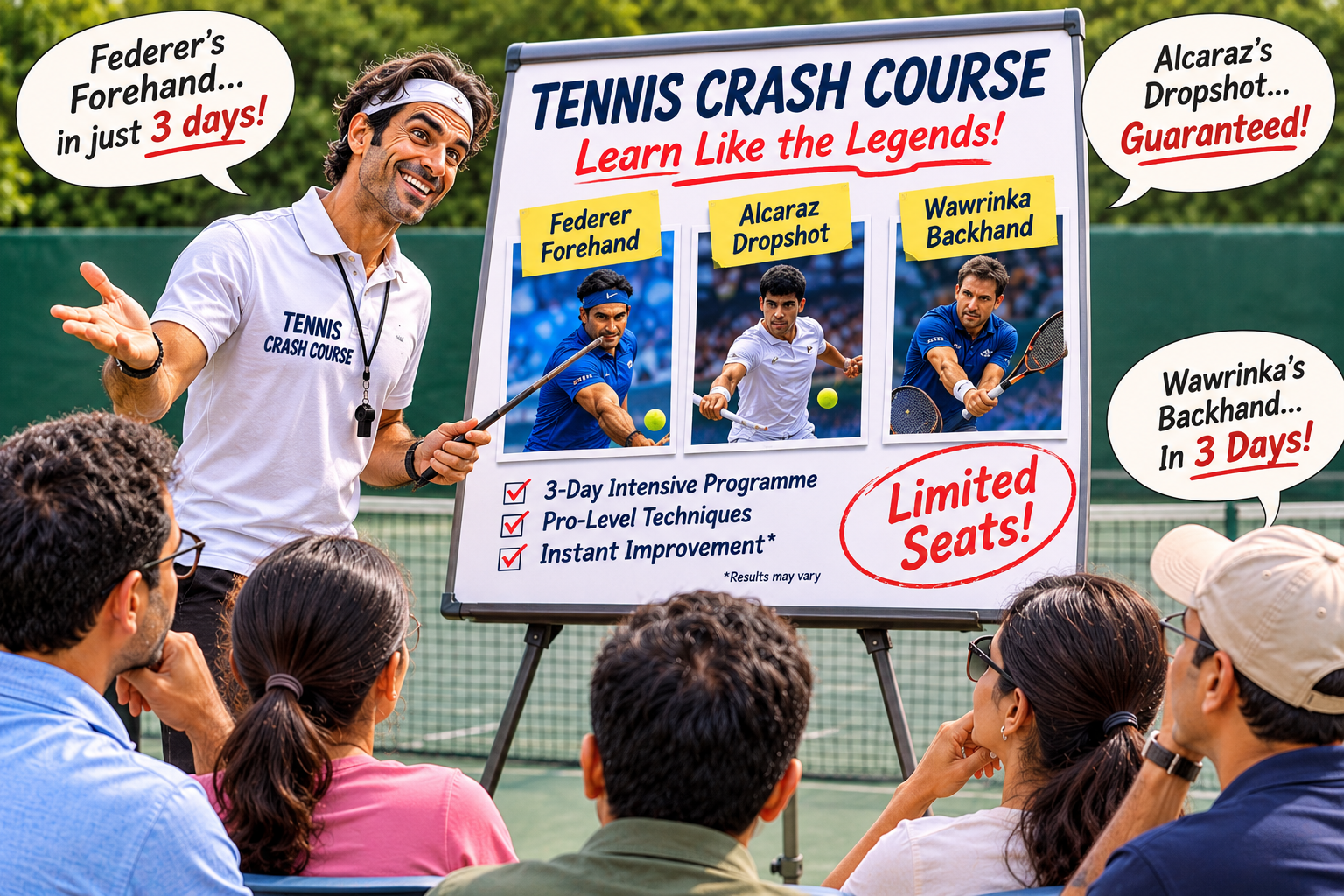
Look beyond impressive titles and promises. Understand the experience, methods and evidence behind the coaching.
WHAT HAPPENED TO THE CHILDREN WHO TRAINED THERE BEFORE?
An academy can display trophies, successful players and its current batch, but what about the children who trained there before? How many improved, how many struggled, how many discontinued and what happened to them? Did the academy maintain records of their training, progress and difficulties? Parents usually see the latest success stories, but rarely get a clear picture of what happened to previous batches. An academy's work should be judged over several years, not just by the players it is showcasing today.
Read the full explanation
One thing I find concerning about tennis coaching is the lack of systematic documentation of a coach's work. Imagine if academies maintained meaningful records of when a child joined, what training was provided, how long the child trained, what progress was made and what eventually happened.
Parents would have a much clearer picture of how an academy actually develops its students instead of relying only on tournament photographs, trophies and success stories.
Giving advice about tennis is easy. Developing a player to a high competitive level is extremely difficult.
Consider an academy that admits a batch of young children, trains them for two or three years and gives their parents high hopes about their future in tennis. Later, some children reach 10th standard, academics become a priority, and they gradually stop competitive tennis.
There may be perfectly understandable reasons why individual children discontinue. But what happens to the academy's earlier batch? Is there an honest record of their development, their difficulties and the reasons they left?
Where is the long-term record showing what happened to the previous batch?
Developing a professional player is extremely difficult, even when a family makes substantial sacrifices for tennis. Giving up education or prioritising tennis does not guarantee a professional career.
My concern is that an academy can keep admitting new batches while the experiences of previous students gradually disappear from public attention. New parents see the latest group of promising children, but may know very little about the students who trained there before them.
There is another situation parents should consider. Suppose an academy promises a specialised two-year programme, collects a premium fee and later relocates. Were the parents informed properly? Were the original commitments addressed? What happened to the children who had joined expecting that programme?
I am not claiming that every academy follows this pattern. I am saying that parents should be able to ask these questions and receive clear answers.
Without records, every new batch can be presented as a fresh success story while the experiences of previous students remain invisible.
Documentation should not just count tournament wins. It should record the training provided, the progress made, the challenges encountered, the duration of the coaching relationship and, where possible, what happened when a student discontinued.
This would also help genuine coaches. A coach who has carefully worked with players for several years should be able to demonstrate that work, including improvements, setbacks and unsuccessful outcomes.
Parents should not expect an academy to guarantee a professional player. But they should be able to understand what the academy actually does and what its previous students have experienced.
Ask about the previous batches, not just the current batch being showcased. A coach's work should be evaluated over time, not only through the latest success story.
CAN ANY COACH GUARANTEE YOUR CHILD A STATE OR NATIONAL RANKING?
A coach may promise that your child will become a state-level player, a national-level player or even a champion within a specific period. But tennis results depend on several factors, including the child's ability, training, health, fitness, discipline, competition, family support and even luck. A coach can assess your child, plan the training and make changes when necessary, but cannot control every factor that determines the final result. Before accepting such promises, ask for the exact ranking target, deadline, conditions and refund policy in writing. A confident promise is not proof that the promised result can be delivered.
Read the full explanation
A coach may tell you that your child will become a state player, a national player or a champion within a certain time.
Ask one simple question.
How can you guarantee that?
Tennis depends on many things: the child's ability, training, health, fitness, discipline, competition, family support and luck.
A coach can plan the work. A coach can assess the player and make changes when something is not working. But nobody can control every factor that decides the final result.
If a coach promises a ranking, ask for the exact target, deadline, conditions and refund policy in writing.
Do not accept a big promise without understanding what happens if it is not achieved.
HOW GENUINE AND RELIABLE ARE TENNIS COACHING CERTIFICATES?
Before being impressed by a tennis coaching certificate, parents should understand how that certificate was obtained. Was the candidate properly examined, or was the certificate issued mainly after attending a course and paying the required fees? Were practical coaching abilities actually tested, or was the assessment limited to theoretical knowledge? Who conducted the examination, what standards were followed, and how difficult was it to obtain the qualification? If someone can obtain a certificate without genuinely demonstrating the knowledge and ability required to coach, what value does that certificate really have? A certificate may look impressive, but parents should question the credibility of the certification process itself before trusting the qualification.
Read the full explanation
One subject I have serious concerns about is the authenticity and reliability of tennis coaching certifications.
Several years ago, I began questioning the way certain tennis coaching certifications were being assessed. I wanted to understand whether these examinations were genuinely capable of establishing an applicant's knowledge and actual ability to coach tennis.
From what I understood of some assessment processes, I had reasons to question whether candidates were always required to demonstrate the abilities that a tennis coach should possess.
I was aware of examination situations in which applicants appeared to be copying answers from one another in front of the certifier. That raised an obvious question for me: what exactly was being assessed?
If an applicant can obtain a coaching qualification without independently demonstrating the required knowledge, how can parents confidently trust that qualification?
I also wondered whether financial incentives could influence the willingness to pass applicants. When people pay substantial amounts to attend certification courses and examinations, could the organisation face pressure to pass more candidates rather than strictly maintain assessment standards?
If failing candidates discourages future applicants and affects certification revenue, could that create a conflict between earning money and maintaining the quality of the qualification?
These are serious questions. A certification process must prove that a candidate has met the required standards, not simply that the candidate has paid the fees and completed the formalities.
I am not claiming that every certification body operates this way, that every certificate is fake or that every certified coach lacks knowledge. These are concerns arising from what I understood and observed about certain assessment situations. I am also not claiming that every organisation follows the same examination process.
But even assuming that a certification examination is conducted very strictly, another important question remains.
Does passing a coaching certification examination actually prove that someone can develop a tennis player?
A qualification may demonstrate that someone has completed a particular course or passed an examination. But how much does it tell parents about that person's ability to teach children, identify technical mistakes, understand different learning abilities, communicate effectively and develop a competitive player over several years?
Who designed the course? How comprehensive is the syllabus? How difficult is the examination? How much practical coaching is evaluated? Are candidates required to demonstrate their ability to observe players, identify problems and make appropriate coaching decisions?
These details matter. A certificate is only as meaningful as the quality of the education, assessment and standards behind it.
I continue to see coaches describing themselves as international or internationally certified coaches. Such descriptions can sound impressive to parents, particularly those who do not have much knowledge about tennis coaching.
But parents should be able to ask what that qualification actually involved, what knowledge it tested, who issued it and how the candidate's practical coaching ability was evaluated.
A certificate should be one piece of evidence, not a substitute for examining a coach's actual knowledge and work.
Ask about the coach's practical experience, playing background, teaching ability and experience working with children. Observe how the coach communicates, identifies mistakes and adjusts the training when a child struggles to understand something.
I am not saying that certifications are useless or that parents should ignore qualifications. I am saying that parents should not automatically assume that a certificate proves everything they need to know about a coach.
The real question is not merely whether somebody has a coaching certificate. It is whether the certification itself is credible and whether the person holding it can actually do the work parents expect.
WHAT CAN AN INTERNATIONAL COACH REALLY CHANGE IN JUST 10–15 DAYS?
Some programmes bring foreign coaches to India for just 10–15 days, sometimes charging around ₹10,000 per day. The international background, impressive titles and high fees can make parents believe that this is an extraordinary opportunity they should not miss. But stop and think. What exactly are you expecting a coach to achieve with your child in those 10–15 days? Are you paying for the actual training being offered, or are you being attracted by the coach's nationality, reputation and the idea that an international coach must be better? Before spending a premium amount, understand what you are actually buying.
Read the full explanation
Another subject I want parents to think about is the short-term international coaching programmes conducted in India and other Asian countries.
Some programmes bring foreign coaches to India for approximately 10 to 15 days. I have seen programmes priced at around ₹10,000 per day. Parents may be attracted by the coach's international background, impressive titles and the opportunity for their children to train with someone from abroad.
But what can a coach realistically develop in a child in just 10 to 15 days?
Tennis development takes years. A player needs time to learn movements, understand the game, practise skills repeatedly, face different opponents and apply what has been learned in competition.
Of course, a short programme can be useful. A visiting coach may identify a problem, explain a concept differently or introduce something that the child's regular coach can continue developing. I am not saying every short visit is useless.
My concern is about the expectations being created and the way these programmes are marketed.
If a coach understands that player development takes years, why should a short programme be presented in a way that makes parents expect major or immediate transformation?
Are parents paying for a clearly defined learning experience, or are they being encouraged to believe that an international coach can provide a shortcut to years of development?
Parents naturally want to give their children every possible advantage. But paying a premium fee does not automatically mean that the child will absorb everything being taught.
Even if the coach explains something useful, the child still needs to understand it, practise it and learn to apply it consistently.
You cannot buy years of development simply by paying a high daily fee to an international coach.
There is another important question: what happens after the visiting coach leaves?
Who continues working on the changes? Does the child's regular coach understand what was taught? Is there a plan to practise the new skills? Is progress reviewed after a few weeks or months? Can the child actually use what was learned during matches?
If these questions have no clear answers, parents may be paying a premium for a short experience without understanding how it fits into their child's long-term development.
I am not saying that foreign coaches are automatically better or worse than Indian coaches. Nationality does not determine coaching ability. What matters is what the coach knows, what the programme provides and what happens after the sessions end.
Before paying for a short international coaching programme, understand exactly what your child is expected to learn and how that learning will be continued.
A short visit can be one part of a child's development. It cannot replace years of consistent work.
DOES KNOWING TENNIS MEAN YOU KNOW HOW TO COACH IT?
Would you trust a maths teacher who cannot solve the problems they teach? Then why do some parents say that a tennis coach does not need to play tennis well because playing and coaching are two different skills? Yes, they are different skills. But how much should a coach understand about actually playing the game, executing shots, moving into position and handling pressure during a match? Where should we draw the line between knowing tennis in theory and understanding it through actual playing experience?
Read the full explanation
Let me talk about another issue in tennis: the difference between being knowledgeable about the game and being capable of teaching it properly.
I have encountered people from other professional backgrounds who entered tennis coaching. Some had useful thoughts about tactics and strategy, but I also saw them discussing technical aspects of tennis and presenting themselves as authorities on those subjects.
There is nothing wrong with coming into tennis from a different background. A person may have valuable knowledge about tactics, strategy, fitness or other areas. But understanding one aspect of tennis does not automatically mean that a person understands every technical detail well enough to teach it to children.
Being a good person and being a technically knowledgeable tennis coach are two different things.
My concern is when people teach beyond their actual knowledge, give confident explanations they cannot properly support and market themselves as experts without recognising the limits of their own competence.
Parents may not have enough tennis experience to distinguish between someone who genuinely understands the game and someone who simply speaks confidently about it.
If you are teaching a child, you must understand what you know, what you do not know and where your knowledge has limitations.
There are also people who enter tennis coaching because they see it as a potentially lucrative career. They see how much parents are willing to spend and assume that they can make money by offering private lessons.
There is nothing wrong with earning a living through coaching. The problem is taking responsibility for a child's development without having the knowledge, experience or ability that parents believe they are paying for.
Coaching is a responsibility, not just a business opportunity.
WHEN A COACH SAYS "I WANT TO GIVE BACK TO TENNIS", WHAT DOES THAT ACTUALLY MEAN?
Many established coaches speak about their passion for tennis and their desire to give back to the sport. But what does giving back actually mean? Is running a commercial academy and collecting coaching fees enough to call it a contribution to tennis? After spending decades in the sport and earning through it, are they also taking responsibility for developing players who cannot afford opportunities, supporting promising young talent or helping the next generation of coaches? When someone speaks about giving back, shouldn't we look at what they actually contribute rather than just listen to what they say?
Read the full explanation
Now let me talk about another group: senior tennis coaches who have established themselves over many years.
Some have spent decades in tennis and have earned well through the sport. Some also repeatedly speak about their passion for tennis and their desire to give back.
What does giving back actually mean?
There is nothing wrong with establishing an academy and charging fees. Coaches have expenses, responsibilities and families of their own. But I question whether simply running a commercial academy is enough to represent the kind of contribution some people claim they want to make.
If established coaches genuinely want to contribute more, why not take up a difficult long-term challenge? They could identify promising children, support talented players who lack financial resources, create development opportunities or help young coaches improve their knowledge.
They could even take on the challenge of helping develop a player towards professional tennis, understanding that nobody can guarantee the final result.
Developing a professional player requires years of work, patience, appropriate facilities, fitness support, tournament opportunities and financial resources. It is difficult, uncertain and demanding.
I sometimes wonder whether the difficulty of that responsibility is why more people do not take it up as a serious long-term commitment.
I am not claiming that every established coach avoids such work or that nobody in India supports talented players. There are people doing valuable work in different ways.
But when somebody repeatedly speaks about giving back, I believe it is reasonable to ask what they are actually doing.
Are they supporting talented children who cannot afford opportunities? Are they helping promising players develop over several years? Are they contributing to coach education, player development or access to the sport?
Passion should mean more than words. Giving back should mean more than marketing.
Parents should also look beyond impressive titles, confident speeches and claims of passion. Ask what the coach understands, what the coach actually does and what can be demonstrated about the work over time.
Are you genuinely working to develop tennis players, or are you only using tennis as a way to build a business?
HOW MUCH REAL COACHING DOES YOUR CHILD GET IN EACH SESSION?
Your child spends one or two hours on the tennis court, but how much of that time is actually spent learning? How much time is spent waiting for a turn, hitting balls without corrections or repeating drills without understanding what needs to improve? Does the coach have enough time to observe each child, identify mistakes and provide individual feedback? What happens when children of different ages and playing abilities are placed in the same batch? Are you paying for court attendance or meaningful coaching?
Read the full explanation
Many tennis academies have different batches: beginners, adults, juniors, intermediate players and advanced players, all scheduled at different times.
At first, this arrangement may look organised. But have you stopped to ask how much meaningful coaching your child actually receives during those sessions?
Learning a tennis skill is not simply a matter of attending a session, hitting some balls and going home. A child needs opportunities to understand the task, practise it, receive appropriate feedback, make adjustments and repeat the movement.
Being present on a tennis court for a fixed amount of time does not automatically mean meaningful learning has taken place.
Imagine a group of ten students who are all at a similar playing level. A coach may be able to explain one concept that is relevant to most of them. They can practise the same task, ask questions and learn from the feedback given to the group.
Now imagine a group containing children of very different ages and playing levels. What an intermediate player needs to understand may be completely different from what a beginner needs.
It is like putting a first-standard student and a fifth-standard student together, teaching them the same lesson in the same way, and expecting both to understand it equally well.
Different children have different learning needs. A coach must be able to address those differences meaningfully.
Separate batches can be a sensible solution. But if an academy has many batches and the main coach has limited hours available, how much meaningful time can that coach spend with each group?
How much time is available to observe an individual child, understand why the child is struggling, correct an error and decide what should happen next?
These are the questions parents should ask instead of assuming that an organised timetable automatically means good coaching.
Some academies also offer additional sessions or private classes. These may be useful, but parents should understand why the extra sessions are needed and what additional value they provide.
I am not saying that every academy with multiple batches is doing something wrong. My concern is whether the number of students, the timetable and the available coaching capacity allow children to receive the attention promised to them.
Do not judge an academy only by the number of sessions it offers. Understand what happens during those sessions.
Ask how students are grouped, how the coach handles different ability levels, how much feedback children receive and whether there is enough coaching capacity to deliver what the academy promises.
If your child attends several sessions every week but is not receiving meaningful instruction, simply adding more sessions may not solve the problem.
The important question is not just how many hours your child spends at the academy. It is how effectively those hours are used to develop your child.
IS YOUR CHILD REALLY FALLING BEHIND BY NOT TRAINING MORE?
Your child is six or seven, and other children are already attending private tennis lessons and training almost every day. Does that mean your child must do the same? Who decided that intensive tennis training at such a young age is necessary? Have you considered allowing your child to explore different sports and physical activities before making tennis the centre of everything? Are you choosing the training schedule based on your child's actual needs, or simply reacting to what other parents are doing? Are you developing your child, or are you competing with other parents?
Read the full explanation
Some parents are made to feel that their children are missing important opportunities if they do not start intensive tennis training or private coaching at a very young age, sometimes as early as six or seven.
They begin to worry that other children are getting more coaching, more court time and more attention. They fear that if they do not do the same, their child will fall behind.
But have you stopped to ask whether doing more tennis at that age is actually what your child needs?
My personal view is that many children should have the opportunity to explore different sports and physical activities until around nine or ten years of age, rather than being pushed into intensive, high-quality tennis training too early.
Different sports provide different movement experiences. Children can develop coordination, balance, agility and an understanding of physical activity without making one sport the centre of everything from the beginning.
This does not mean young children should never play tennis or that every child must follow exactly the same schedule. Every child is different.
My concern is when parents are made to believe that frequent private sessions and intensive tennis training from six or seven years of age are essential, without first considering the child's actual needs.
Are you making decisions based on your child's development, or are you reacting to what other parents are doing and what coaches are telling you your child might miss?
When an academy recommends more sessions, ask what those sessions are meant to achieve. What can the child currently do? What needs to improve? Why is the additional training necessary at this stage?
More sessions are not automatically better simply because the child is young. Nor does another child attending private lessons prove that your child must do the same.
Do not let the fear of your child falling behind push you into doing more without understanding why.
Your child is developing as a person and as a mover, not simply preparing to become a tennis player.
The question is not whether your child is doing as much tennis as everyone else. The question is whether the training you choose makes sense for your child at that stage of development.
DOES ONE GIFTED PLAYER PROVE AN ACADEMY CAN DEVELOP EVERY CHILD?
An academy showcases a talented child who has improved considerably under its coaching. But how much of that improvement came from the coaching, and how much came from the child's natural ability? Was the child already talented before joining? What about the other children who trained under the same coach? How many have made meaningful progress? How does the academy work with children who do not learn as quickly or have the same natural abilities? Are you judging an academy by one successful player or by its ability to develop children with different abilities?
Read the full explanation
There may be one child in an academy who is naturally gifted at tennis. The child may learn movements quickly, understand the game well and develop certain skills more easily than others.
What do some academies do? They showcase that player and advertise the child's improvement, sometimes giving parents the impression that the coach alone transformed the player's game.
But how much of that player's development came from coaching, and how much came from the child's natural ability?
A coach may genuinely have helped a gifted child improve. I am not denying that. My concern is when an academy takes credit for the entire transformation without acknowledging the child's starting ability, learning speed and natural connection to the sport.
Parents see one successful player and begin believing that the same academy can produce the same results for their own child.
But not every child has the same natural flair for tennis. Children differ in their movement skills, coordination, ability to learn and response to training. The same coaching approach does not automatically produce the same results in every child.
One child's success is not proof that the same programme will produce the same outcome for every other child.
Before accepting an academy's success story, ask what the player was like before joining. What did the academy actually do to help the child improve? What was the training process? How long did it take?
Also ask about the development of other students. What progress have they made? What difficulties have they faced? How does the academy work with children who learn at different speeds?
These questions matter because parents are often shown the success story, not the complete picture of how different students develop.
This does not mean naturally gifted children do not need good coaching. They do. It means we should not confuse a child's natural ability with proof that an academy can reproduce the same result in everyone.
Understand the difference between discovering a gifted player, helping that player improve and having a coaching system capable of developing children with different abilities.
YOUR CHILD LOOKS GREAT IN PRACTICE—WHY DOES IT NOT SHOW IN MATCHES?
Your child hits beautiful shots when the coach feeds the balls, but what happens when an opponent starts playing? Can your child handle different ball speeds, placements and directions? Can the child move into position, maintain balance, make decisions and execute those same shots independently? When your child keeps losing matches, is it always because of nervousness or pressure? Have you considered whether the practice sessions are actually preparing your child for real match situations? Are you watching your child's tennis ability, or simply watching how well your child handles comfortable feeds?
Read the full explanation
A child can look very good during a coaching session without necessarily being able to reproduce the same performance in a match.
One reason is the way the coach feeds the ball.
Coaches often feed balls in a controlled way to help children learn a particular shot, maintain rhythm and practise a movement. There is nothing wrong with that. It is an important part of teaching tennis.
But what exactly are you watching? Are you seeing your child's ability to play tennis, or are you seeing how well your child performs when the coach controls the feed?
In a match, the child does not receive the same comfortable feed. An opponent may change the pace, vary the placement or make the child move. The player must read the situation, get into position, make decisions and execute the shot under different conditions.
A child who hits beautiful shots from predictable feeds may struggle when the ball arrives differently during competition. That difference needs to be understood rather than hidden behind an impressive practice session.
Here is where I have a concern.
A coach may show parents that their child is hitting well during practice. When the child continues losing matches, the explanation may be that the child is nervous or unable to handle pressure.
Of course, nerves and match pressure can affect performance. But they should not automatically become the explanation for every loss.
What if the child struggles with movement, timing, consistency or decision-making when the opponent changes the situation? What if the practice performance is not an accurate picture of the child's current match ability?
Parents must distinguish between a child hitting well during a controlled drill and a child being able to use that skill independently in a match.
Ask what the drill is designed to develop. Is the coach making the task progressively more difficult? Can the child apply the skill when the feeds change and when movement is required?
I am not saying that every coach who uses controlled feeds is misleading parents. Controlled feeding is a normal part of teaching. My concern is when a good-looking practice performance is presented as proof of overall ability while repeated match problems are explained away without examining them.
A practice session should help develop your child's game. It should not create an impression that hides what still needs to improve.
IS IT A TENNIS ACADEMY OR A BUSINESS CENTRE?
Who is actually running the academy—a person genuinely focused on developing tennis players, or businessmen who have invested money and expect returns? Who decides how many children must be enrolled, how much parents should be charged and what services should be sold? Are coaches free to make decisions based on what each child needs, or are they expected to follow business targets set by people who may have little understanding of player development? When recovering an investment becomes a priority, does the child's development still come first? Are parents paying for tennis coaching, or helping someone recover their business investment?
Read the full explanation
This is a situation I want parents to think about, particularly when choosing tennis coaching centres in gated communities and other residential locations.
Not every coaching centre is necessarily owned or managed by someone with a background in tennis. Some centres may be funded by businessmen or investors who see an opportunity to make money through tennis coaching.
There is nothing wrong with investing in a tennis facility or running a profitable academy. Businesses need revenue to operate. Coaches deserve to be paid, and people who invest their money are entitled to expect a return on their investment.
But what happens when recovering the investment becomes more important than developing tennis players?
Imagine someone invests money in a tennis centre. The investor wants to recover that money and eventually make a profit. The person managing the centre may start focusing on increasing student enrolment, collecting fees and generating more revenue.
Who decides how many children should be enrolled? Who decides how many children a coach must handle? Who decides the fees, the number of sessions and the additional services parents should pay for?
Are these decisions being made according to the actual requirements of player development, or according to the financial targets of the business?
And where does the coach fit into this arrangement?
A coach may genuinely want to teach children properly and may be working hard with the knowledge and experience they have. But what if the management decides how many students the coach must handle, how much time can be allocated to each batch and what the overall programme should look like?
What if the coach wants to give individual attention but the business wants more enrolments? What if the coach believes a child needs a particular type of training but the management is more interested in selling additional sessions?
In such situations, should we blame only the person conducting the session? Or should we also examine the people who designed the system and control the working conditions?
I have also come across arrangements in which someone organises the sessions and shares the income with the person actually conducting them. Parents may not even know who is responsible for the coaching decisions or how the arrangement works.
Some individuals teaching children may have only a few years of playing experience. Being able to hit the ball reasonably well does not automatically mean they have the knowledge and experience required to coach young players.
But I would also ask a different question: who hired these coaches, who is supervising them and who is responsible for ensuring that the service being sold to parents is actually being delivered?
If management is collecting the fees, controlling the coaching arrangements and deciding how the centre operates, management must also take responsibility for the quality of the programme.
Parents are busy with their own lives. They may not have enough tennis knowledge to assess the playing ability, technical understanding or coaching experience of the person conducting their child's sessions.
They may see a well-maintained facility, a confident person, organised batches and a professional-looking setup. Everything may appear perfectly organised from the outside.
But does that tell you who actually understands tennis, who plans the training and who is responsible for developing your child?
My concern is not only about parents potentially losing money. Your child's time is being spent too, and that time cannot be returned later.
Before joining such a centre, ask who owns and manages it, who actually conducts the sessions, what experience those coaches have, who decides the training programme and how the development of individual children is monitored.
Most importantly, find out whether the centre is designed to develop tennis players or primarily to generate revenue through tennis coaching.
I am not saying that every businessman investing in tennis is doing something wrong, or that every commercially operated academy provides poor coaching. A properly managed business can provide good facilities, employ capable coaches and create genuine opportunities for children.
But investors, owners and management must understand that tennis coaching is not simply about filling courts, collecting fees and recovering investments. There are children whose development and valuable years are involved.
A tennis academy should be judged not just by its facilities, number of students or revenue, but by the quality of coaching it actually provides.
WHO IS REALLY TRAINING YOUR CHILD'S BODY?
Does your child's fitness trainer have the knowledge, experience and ability to prepare young tennis players? Now, let's assume you find a terrific trainer who is highly knowledgeable and experienced. What kind of programme is actually running at that training centre? Is there a proper system, or does everything depend on that one trainer being personally present? Is the programme sustainable? Can the same quality be maintained when more children join? What happens when the trainer is sick, travels or decides to leave? Is there a trained team that can continue the programme without disruption, or does everything come to a standstill? Are you choosing a good trainer, or are you choosing a good training system that can consistently deliver quality even without that one individual?
Read the full explanation
I have tried different fitness trainers for my students. I made mistakes, learned from them and changed my approach.
Here is what I want parents to understand.
1. KNOWING A LOT IS NOT ENOUGH.
I once worked with a very experienced and knowledgeable fitness trainer.
He had years of experience and knew a lot about fitness. But his centre ran sessions from early morning until late at night. Children from different sports could come at different times.
I started asking myself a few questions.
Does every child have a proper plan?
Does the trainer know what that child needs?
Is the trainer checking progress?
Is the training designed for the child's sport, age and ability, or is the child simply attending a fitness session?
A trainer may know a lot and still not be the right person for every child.
Knowledge matters. But how you use that knowledge matters just as much.
2. DOES YOUR FITNESS SESSION HAVE A PURPOSE?
I have also seen fitness sessions where children keep doing exercises, but the sessions look boring and disconnected from what they need on the tennis court.
Fitness training does not have to be entertaining every minute. Some exercises are repetitive because the body needs practice.
But there should be a reason for what the child is doing.
What is the purpose of the exercise?
What ability is it trying to improve?
Is the child performing it correctly?
How will the trainer decide when to make it harder or move to something else?
If the child has been doing similar exercises for months, ask the trainer what has changed and what progress has been observed.
Making a child tired is not the same as making a child fitter.
3. CAN A FITNESS TRAINER TEACH TENNIS MOVEMENT?
A fitness trainer does not have to be a tennis player to teach general strength and conditioning.
But there is a difference between improving general fitness and teaching tennis technique.
If a trainer starts telling a child how to swing a racket, which foot to plant for a particular shot, or how to move during a tennis situation, ask about the trainer's experience in those areas.
Does the trainer understand the demands of tennis?
Has the trainer worked with tennis players?
Can the trainer explain why the movement is being taught that way?
A certificate in fitness does not automatically make someone a tennis coach.
Know where your expertise ends. And make sure the person training your child understands the job they have been hired to do.
4. I MADE A MISTAKE MYSELF.
I once hired a gymnast because I thought the children would benefit from flexibility training.
I did not ask enough questions about the trainer's experience working with children of that age.
Some children were injured and had to stay away from training for around two months.
I take responsibility for my decision. I assumed that because the person had gymnastics knowledge, they would automatically know how to work safely with my students.
I should have checked their experience with children of that age, how they planned the sessions, how they increased the difficulty and how they handled safety.
I did not investigate these things properly before hiring the trainer.
That mistake was mine.
Being young does not automatically make someone competent. Being experienced in one area does not mean someone is suitable for every job.
Before trusting someone with your child's body, ask the right questions.
5. DON'T SELECT A TRAINER JUST BECAUSE OF A CERTIFICATE.
A certificate may show that someone has completed a course. It does not tell you everything about how they will train your child.
Ask about their practical experience.
Have they worked with children of your child's age?
Have they worked with tennis players?
Can they explain the purpose of their exercises?
Do they know how to progress training gradually?
Can they recognise when a child needs to stop or when a problem needs assessment by a qualified health professional?
You do not need to insult a trainer or question every qualification. You simply need to check whether the person is suitable for your child.
6. WHAT DID I CHANGE?
After these experiences, I started reading more and questioning my decisions.
I attended a sports and fitness event where I listened to orthopaedic doctors, physiotherapists and nutritionists. I began looking more carefully at how fitness training should support tennis and how different professionals can contribute to a player's development.
I am still learning. I will make mistakes, and I must be prepared to correct them.
But I will not hire someone simply because they have a big name, an impressive body or a qualification.
I want to understand what they can do, what experience they have and whether their work suits the needs of my students.
7. DOES THE ENTIRE PROGRAMME DEPEND ON ONE TRAINER?
Let's assume you find a terrific fitness trainer. The person is knowledgeable, experienced and genuinely capable of training children.
Now look beyond the individual trainer. What kind of programme is actually running at that centre?
Is there a structured system with training plans, proper assessments, progress records and clear methods that other trainers can follow?
Or does everything depend on that one trainer being personally present and conducting every session?
What happens when the trainer falls sick, travels, takes a holiday or decides to leave? Will the programme continue without interruption, or will the children suddenly lose the quality of training they were receiving?
Are there other properly trained people who understand the programme and can maintain its standards?
A good trainer is valuable. But a good trainer alone does not automatically make a good training centre.
Now imagine that the trainer becomes popular and the centre starts accepting more children. Can the same quality be maintained when the programme expands? Can the trainer personally supervise every child? Are additional trainers properly trained to follow the same programme, or does the quality gradually depend on whoever is available?
Scaling a programme is not simply about adding more children, trainers and training hours. The centre must be able to maintain the quality of its work as it grows.
Before choosing a fitness centre, look at the system behind the trainer. Ask whether the programme can continue delivering consistent quality even when the main trainer is not present.
BEFORE YOU CHOOSE A FITNESS TRAINER, ASK THESE QUESTIONS.
What is the plan for my child?
Why are these exercises being used?
Does the trainer have experience with children of this age?
Does the trainer understand the demands of tennis?
How will progress be checked?
How will training difficulty be increased safely?
Who will take responsibility if something goes wrong?
What happens when the main trainer is unavailable?
Is there a system and a trained team to maintain the programme?
Can the centre maintain the same quality when it accepts more students?
You do not need to know all the answers yourself. The trainer or centre should be able to explain the programme in simple words.
Don't choose a trainer based only on reputation, certificates or appearance. Find out whether the person knows how to train your child properly, and whether the programme can maintain that quality over time.
YOU LIKE THAT FOREHAND—BUT DO YOU KNOW WHAT MAKES IT WORK?
You watched a player hit a beautiful forehand and now want your child to hit the same way. But have you looked at how that player moves towards the ball, positions the feet, maintains balance, rotates the body and times the shot? Are you looking only at the final movement of the racket while ignoring everything that happens before contact? Can you simply copy another player's forehand and expect it to work for your child? Are you asking your coach to solve your child's actual problem, or simply reproduce a shot that you liked watching?
Read the full explanation
Once, a parent told me that a player they had watched in a tournament had a very good forehand.
The parent wanted their child to hit the forehand in the same way.
I tried to explain that a forehand is not just about the hand and racket.
Look at the whole player.
How does the player move towards the ball? How does the player place their feet? Can they keep their balance? How do they turn their body? How well do they time the shot? How do they use their legs, hips, body and arm together?
The hand is only one part of the movement.
But the parent dismissed my explanation. They wanted me to teach their child to hit the ball like the player they had seen.
They were looking at how the shot appeared. I was trying to explain what helped produce it.
That conversation made me realise something.
Sometimes, parents want the result they can see without understanding the work behind it.
A GOOD-LOOKING SHOT DOES NOT TELL YOU EVERYTHING.
Two players may hit forehands that look different.
One player may have a bigger swing. Another may have a shorter swing. Their bodies, movement abilities, timing and playing styles may be different.
You cannot simply copy one player's movement and expect it to work equally well for every other player.
A coach must understand what the individual player needs.
Sometimes, the problem is technique. Sometimes, it is poor movement, balance, timing or positioning. Sometimes, several things need to change together.
The coach has to identify the problem before deciding what to change.
THEN WHY DO PARENTS ASK FOR THE SAME SHOT?
Because the shot is easy to see.
The movement that came before it is harder to notice. The hours of practice are harder to see. The player's physical abilities and years of development are not always obvious to someone watching from outside.
So a parent sees a beautiful forehand and says, "Make my child hit like that."
But that is not a complete coaching instruction.
What exactly should change? The preparation? The contact point? The timing? The body rotation? The footwork?
And is that really the main problem holding the child back?
These are questions the coach should investigate.
ASK QUESTIONS. BUT UNDERSTAND THE DIFFERENCE.
I don't expect parents to know everything about tennis. If you already knew everything, you would not need a coach.
Ask me why I am changing something. Ask what the problem is. Ask how we will work on it.
I should be able to explain my decisions in words you can understand.
But there is a difference between asking for an explanation and demanding that I copy another player's style simply because you like it.
You are paying me to coach your child, not to copy whatever you saw at a tournament.
I may agree with your observation. I may disagree with your conclusion. What matters is whether we understand the actual problem and work towards solving it.
BEFORE YOU ASK FOR A BEAUTIFUL FOREHAND, ASK THIS.
Is my child moving well?
Is the child reaching the ball in a good position?
Can the child maintain balance?
Is the contact point suitable?
Is the timing good?
Does the child understand what they are trying to do?
What is the coach actually trying to improve?
You do not need to become a tennis expert to ask these questions. You only need to look beyond the final shot.
A forehand is not a photograph. It is the result of a movement.
If you want your child to improve, don't just ask the coach to copy what looks good. Ask the coach to explain what needs to work better.